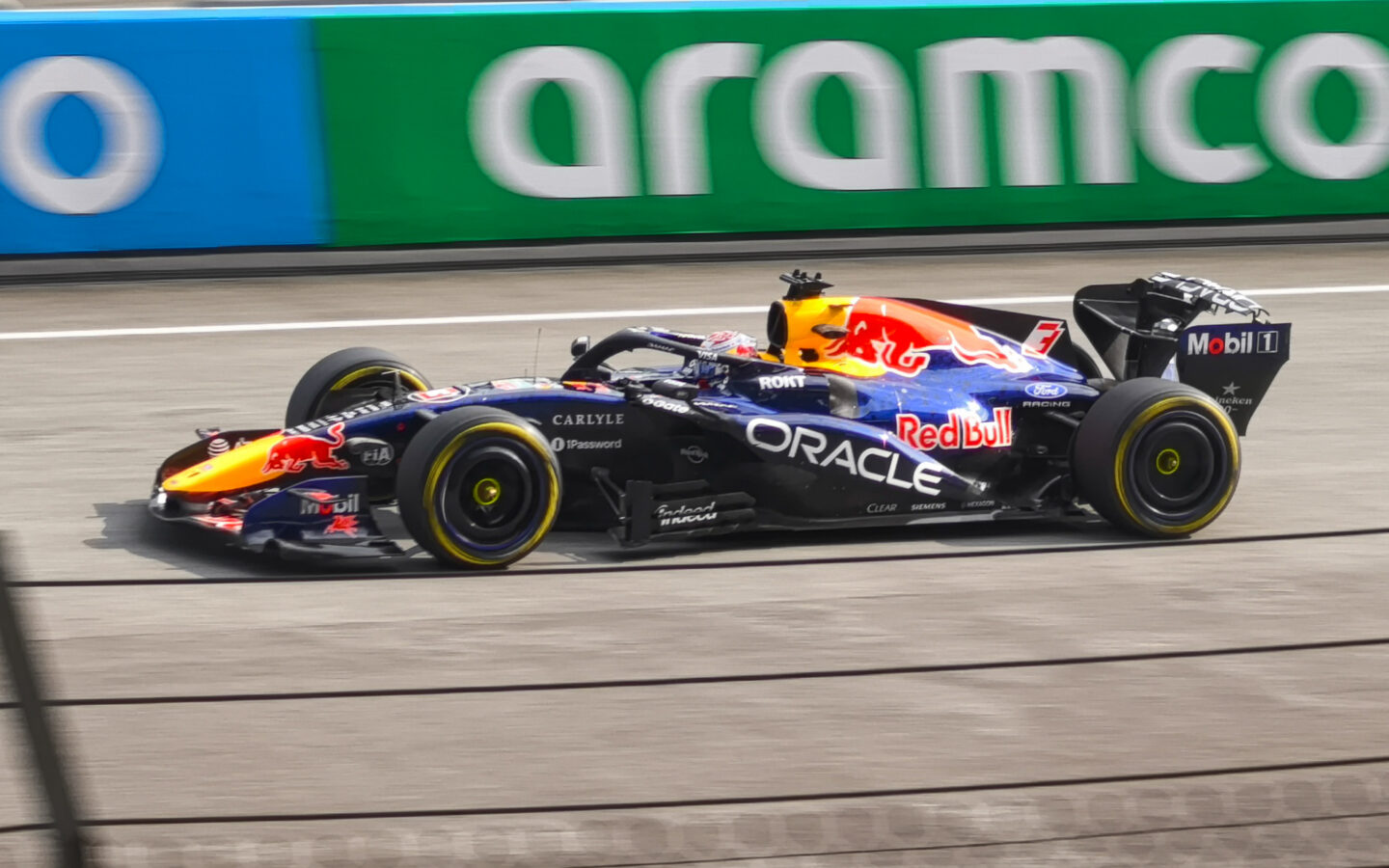
Max Verstappen won a chaotic Formula One sprint race in Singapore after rain delayed the start, George Russell crashed while leading and McLaren teammates Lando Norris and Oscar Piastri collided in the closing laps. The Red Bull driver recovered from a poor launch off pole position to take victory at the Marina Bay Street Circuit, finishing ahead of Lewis Hamilton and Charles Leclerc. The race produced a record number of sprint retirements and renewed debate about whether the narrow Singapore street layout is suitable for the format.
Verstappen lost the lead immediately
Heavy rain before the race left different parts of the circuit with dramatically different grip levels. All drivers started on intermediate tires. Verstappen had what he later described as a “horrendous” launch, allowing Mercedes driver George Russell to move ahead.
Russell initially appeared to have the faster car in the slippery conditions. That advantage lasted less than a lap.
Russell crashed at the final corner
At the end of the opening lap, Russell lost control at the final corner and hit the barriers. The crash removed the early leader and returned Verstappen to first place.
The incident brought out the safety car and changed the rhythm of the race. Once racing resumed, Verstappen controlled the pace and managed his tires as the track gradually dried.
Verstappen handled changing conditions better than his rivals
Singapore’s street circuit is difficult in dry conditions because of heat, walls and limited runoff. Mixed weather adds another layer of risk. Drivers must judge where grip is available while tires move in and out of their ideal temperature window.
Verstappen avoided major mistakes after retaking the lead. He steadily opened a gap and finished 2.591 seconds ahead of Hamilton.
Hamilton finished second
Lewis Hamilton produced a controlled race to take second place, while Ferrari teammate Charles Leclerc completed the top three. Kimi Antonelli and Liam Lawson finished fourth and fifth.
The result gave Hamilton useful points in a weekend where strategy and survival mattered almost as much as outright pace.
The McLarens collided late
The most controversial moment came on the final lap. Norris attempted to pass teammate Piastri while the pair were fighting behind Leclerc. Norris clipped Piastri’s rear tire, sending both cars into spins.
Norris apologized over team radio and later said he believed he had enough space. Piastri retired, while Norris recovered to finish eighth and score the final sprint point.
McLaren faces an awkward internal dynamic
Teammate collisions are especially costly when both cars are competing near the front of the championship. Teams want drivers to race, but they also need to protect points and avoid expensive damage.
The Singapore contact was not for the race lead, which may make it more frustrating for the team. Mechanics also faced a tight turnaround to repair both cars before qualifying.
Nine retirements made the sprint unusually attritional
The race produced nine retirements, a record for an F1 sprint event. Wet conditions, narrow barriers and limited overtaking space contributed to the high attrition.
Six laps were completed under the safety car. That reduced the amount of flat-out racing and strengthened criticism of the sprint format at Marina Bay.
Verstappen and Hamilton questioned the circuit’s sprint suitability
After the race, both Verstappen and Hamilton argued that Singapore is not an ideal venue for sprint racing. The track has relatively short straights and few conventional overtaking zones.
Verstappen said even the sport’s new overtaking systems were difficult to use effectively. Hamilton similarly suggested the layout would need changes if Formula One wanted more passing in shorter races.
Singapore will not host a sprint next year
The 2026 Singapore event was the final sprint on this season’s calendar. The circuit is not included in next year’s expanded 10-sprint schedule.
That decision may reduce pressure to redesign the format for Marina Bay, though debate will continue because other street circuits remain part of Formula One’s plans.
The championship impact
Verstappen’s victory gave him eight points and helped him move ahead of Norris in the standings. Sprint points are smaller than Grand Prix points, but close championship battles can make them significant.
The larger opportunity still comes in Sunday’s race. Teams now have qualifying and the full Grand Prix ahead, and the sprint’s crashes may affect setup choices and spare-parts availability.
A win built on recovery rather than a perfect start
Verstappen’s sprint was notable because his first few seconds were poor. The race turned when Russell crashed, but Verstappen still had to manage changing grip and repeated restarts without making a mistake.
For Red Bull, the result confirmed that the car is competitive on a circuit historically considered difficult for the team. For McLaren, the priority shifts to repairing cars and containing the consequences of an avoidable teammate collision before the main race.

Sources
- Formula 1 official race report and results
- Reuters, Oct. 10, 2026