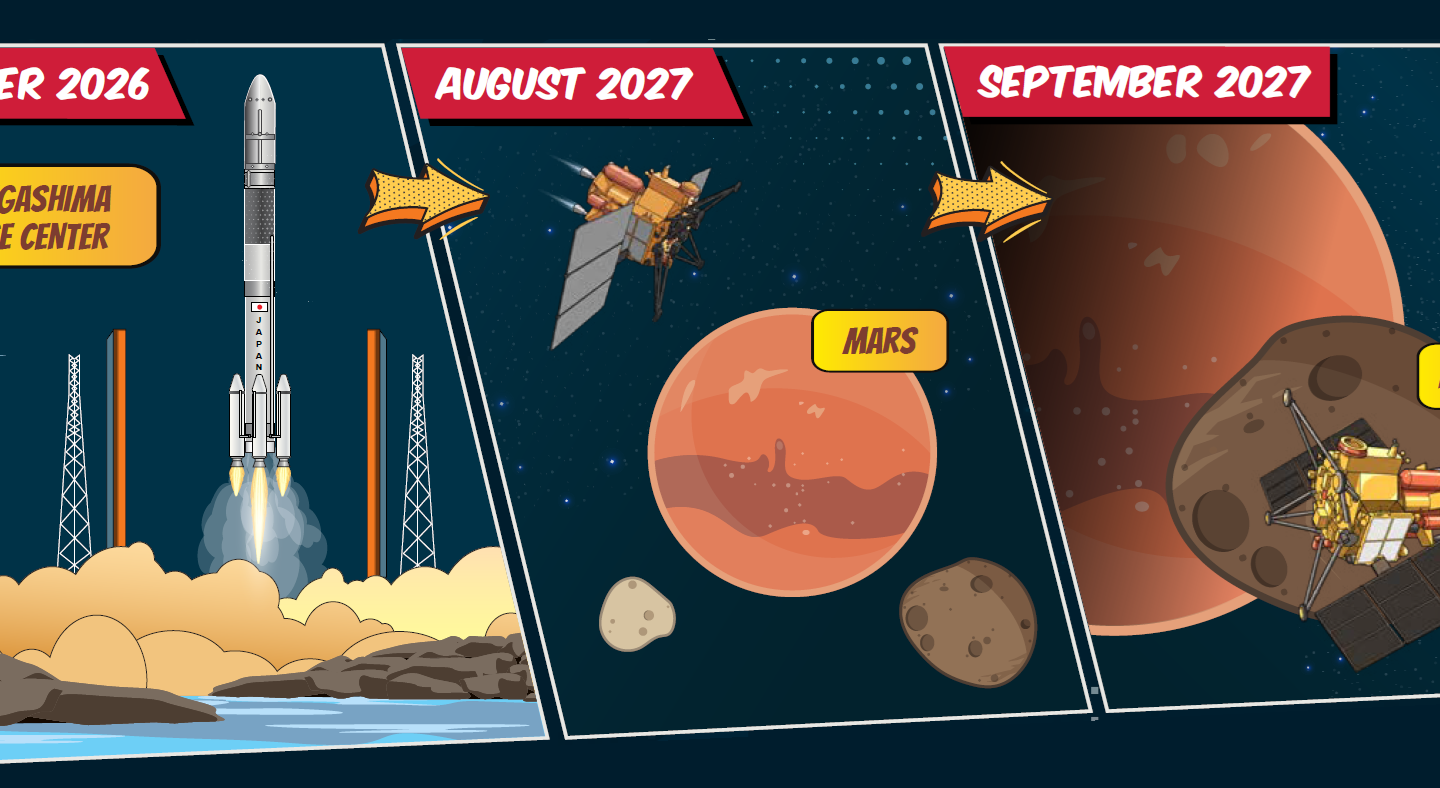
Japan’s space agency has set Oct. 20 for the launch of the Martian Moons eXploration mission, or MMX, a five-year project designed to collect material from Phobos and return it to Earth. JAXA said the spacecraft will lift off aboard an H3 rocket from the Tanegashima Space Center at 4:41:03 a.m. Japan time. If successful, MMX would become the first mission to return samples from the Mars system and could resolve a long-running debate over how Mars’ two small moons formed.
MMX will target Phobos first
The mission will travel to Mars, study both Phobos and Deimos and make repeated close approaches to Phobos. JAXA plans to land on the moon’s surface, collect at least 10 grams of material and store it in a return capsule.
That sample will then begin the long journey back to Earth, with arrival planned for 2031. The mission profile builds on Japan’s successful Hayabusa and Hayabusa2 asteroid sample-return programs.
Why Phobos matters
Scientists still do not know whether Phobos and Deimos are captured asteroids or fragments created by a giant impact on early Mars. Their shapes and dark surfaces resemble some primitive asteroids, but their nearly circular equatorial orbits are difficult to explain with a simple capture scenario.
A laboratory sample could provide mineral, isotopic and chemical evidence that remote sensing cannot match.
Ten grams could answer large questions
JAXA’s goal of returning at least 10 grams may sound small, but planetary laboratories can perform many different tests on milligram-scale samples.
Scientists can measure isotopes, determine mineral ages and search for traces of material blasted off Mars by ancient impacts. Those measurements could reveal how material moved through the early inner solar system.
The mission includes international instruments
MMX is a Japanese-led project with major contributions from international partners. NASA supplied the MEGANE gamma-ray and neutron instrument, while European institutions contributed a small rover known as Idefix and other scientific hardware.
The collaboration makes MMX one of the most internationally integrated deep-space missions currently preparing for launch.
Phobos is difficult to land on
Phobos has extremely weak gravity, meaning a spacecraft cannot land the way it would on Earth or Mars. A poorly controlled descent could cause the vehicle to bounce away from the surface.
MMX must approach slowly, control its contact with the surface and collect material without disturbing the spacecraft’s stability.
JAXA will use two sampling techniques
The spacecraft is designed to use more than one method to gather material. One system relies on a coring mechanism, while another uses a gas-driven approach to move loose surface material into a collection chamber.
Using different techniques reduces the risk that one type of terrain prevents successful sampling.
The H3 rocket is central to the mission
MMX will launch on Japan’s H3, the country’s newest large launch vehicle. H3 is intended to lower launch costs and support a wide range of government and commercial missions.
A successful MMX launch would therefore be important not only for planetary science but also for Japan’s broader launch program.
The mission could help prepare for human Mars exploration
Phobos has sometimes been discussed as a possible staging point for future human missions because of its low gravity and proximity to Mars.
MMX is not a crewed exploration project, but the navigation, sampling and operations experience gained around the Martian system could inform later missions.
Launch timing is precise
JAXA set a specific launch time because interplanetary missions must depart Earth within a limited geometry that allows the spacecraft to reach Mars efficiently.
The agency has also reserved a backup period through early November if weather or technical issues delay the first attempt.
A five-year journey begins with one launch window
The most difficult parts of MMX will come years after liftoff: Mars arrival, surface operations, sampling and Earth return. But none of those stages can begin unless the H3 successfully places the spacecraft on its interplanetary trajectory.
For planetary scientists, the payoff could be historic. A small container of Phobos material may help explain not only the origin of Mars’ moons, but also the history of the early solar system.
Sources
- JAXA launch announcement, Oct. 18, 2026
- JAXA MMX mission overview
- NASA Science MMX mission materials
- Associated Press, Oct. 18, 2026