
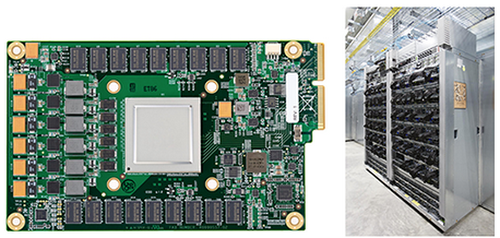
OpenAI is planning to purchase Google artificial-intelligence chips, The Information reported, a move that would deepen commercial ties between two companies that compete directly in AI products and search. Reuters reported the potential deal on Wednesday, citing the publication’s account of a person familiar with the matter.
OpenAI already relies heavily on Nvidia GPUs, but the company began renting Google Tensor Processing Units in 2025. A direct purchase would signal a broader effort to diversify compute supply and lower infrastructure costs.
TPUs are becoming a serious alternative
Google has spent more than a decade developing its own Tensor Processing Units for machine-learning workloads. The chips are optimized for large-scale training and inference and are increasingly being offered beyond Google’s internal services.
Anthropic is already a major TPU customer, and Oracle announced this week that it will offer Google TPUs on its cloud infrastructure starting in 2027.
Nvidia still dominates training
Nvidia remains the leading supplier of accelerators for frontier AI models. Its software ecosystem, networking technology and broad developer support create a substantial competitive advantage.
But customers are increasingly looking for alternatives as AI spending reaches unprecedented levels and demand for high-end GPUs remains intense.
OpenAI wants more supplier diversity
OpenAI’s infrastructure strategy already spans Microsoft, Oracle, Google Cloud and other partners. Adding more direct access to Google chips would reduce dependence on any single supplier.
Diversification can also give OpenAI greater leverage when negotiating capacity, pricing and long-term supply agreements.
Google gains from selling chips to a rival
OpenAI competes directly with Google in generative AI, search and productivity software. Yet Google can still profit from supplying infrastructure to its rival.
The same dynamic is common in cloud computing, where competitors often buy one another’s services when it makes economic sense.
The economics of AI are under scrutiny
Amazon, Microsoft and Alphabet plan to spend as much as $600 billion combined on AI infrastructure this year. Investors are increasingly asking whether the revenue generated by AI services will justify that scale of capital expenditure.
Cheaper or more efficient chips could materially improve the economics of model training and inference.
Custom silicon is reshaping the market
Google TPUs are part of a broader move toward specialized accelerators. Amazon has Trainium, Microsoft has Maia, and OpenAI has been working with Broadcom on a custom chip expected to begin deployment by the end of 2026.
The market is therefore shifting from a single dominant architecture toward a mix of GPUs and purpose-built silicon.
Inference may drive the next phase
Training frontier models requires enormous compute clusters, but the long-term cost of serving those models to billions of users may be even larger.
That makes inference efficiency a key competitive battleground. Chips optimized for specific workloads can offer better performance per dollar and per watt.
Cloud alliances are becoming more flexible
OpenAI recently said its advanced models would be available through Google Cloud, expanding a relationship that would have seemed unlikely only a few years ago.
AI companies increasingly treat infrastructure as a multi-cloud problem rather than a single-vendor commitment.
A purchase would be strategically significant
No detailed terms have been disclosed and neither company has publicly confirmed the reported transaction. Even so, a direct OpenAI purchase of Google TPUs would be a notable sign that Google’s chip business is becoming a broader commercial platform.
It would also reinforce the pressure on Nvidia to defend its position not only against other chipmakers, but against the custom silicon of the world’s largest cloud companies.
Sources
- Reuters, Oct. 28, 2026
- The Information report cited by Reuters
- Google/Oracle TPU announcement, Oct. 27, 2026 — primary source
Power efficiency is becoming a strategic constraint
AI companies are no longer focused only on raw compute. Electricity availability has become one of the biggest constraints on data-center expansion, making performance per watt increasingly important. Custom accelerators such as TPUs can therefore compete on energy economics as well as chip price.
That matters for OpenAI because its inference workloads are growing rapidly as more users and enterprise customers adopt AI products. Even small efficiency gains can translate into major savings at hyperscale.
The deal would blur competitive boundaries
Google and OpenAI compete in models, search and productivity tools, but infrastructure economics are pushing them into closer commercial relationships. The same company can be a rival in software and a supplier in compute. That pattern is becoming normal across the AI industry.