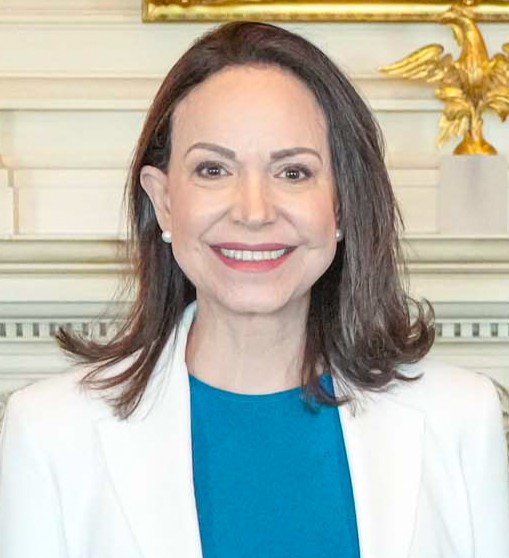
Venezuelan opposition leader María Corina Machado returned to the country on Sunday after months abroad, reappearing publicly for the first time since leaving to receive the Nobel Peace Prize. Supporters gathered along her route toward Caracas as she renewed demands for a presidential election and a broader democratic transition. Her return adds a new source of political pressure on acting President Delcy Rodríguez, whose interim government has not set an election date.
A symbolic return with real political risk
Machado’s presence inside Venezuela carries far more weight than speeches from abroad. She has spent years challenging the ruling political system and retains a highly organized opposition network.
Returning also exposes her to greater security and legal risk in a country where opposition figures have faced detention and political restrictions.
Supporters lined her route
Images and witness accounts showed supporters gathering as Machado traveled toward Caracas. She appeared at a church in Lara state before continuing east.
The crowds offered her movement an opportunity to demonstrate that it still has street-level support despite months of political uncertainty.
The election demand is the central issue
Machado and her allies want the government to announce a credible presidential election. The opposition argues that the country cannot normalize politically while the interim arrangement continues without a clear electoral timetable.
Acting President Rodríguez has said Venezuelans will determine the right moment for the next vote, but no date has been set.
Washington’s position is complicated
The Trump administration has supported reconciliation talks and economic stabilization while maintaining ties with Rodríguez’s government. That has frustrated parts of the opposition that expected Washington to push more aggressively for immediate elections.
U.S. officials said the talks helped create conditions for Machado’s safe return.
Trump distanced himself from the operation
Asked about Machado’s return, President Donald Trump said he did not know the details and emphasized that his administration was doing well in its dealings with Venezuela.
That public distance contrasts with reports that regional governments and U.S.-linked security arrangements helped coordinate her journey.
Maduro’s removal changed the landscape
Venezuela’s political system has been in flux since Nicolás Maduro was removed from power in a U.S. military operation earlier in 2026. Rodríguez, a longtime Maduro ally, assumed the interim presidency.
The transition created expectations that elections could follow, but the timetable has remained uncertain.
Machado’s political support has shifted
Machado remains the most internationally recognized opposition figure, but her close alignment with Trump has also cost her support among some Venezuelans.
Critics argue that foreign pressure should not determine Venezuela’s political future, even if they oppose the former Maduro government.
Economic stabilization competes with democratic urgency
Washington and parts of the Venezuelan establishment argue that courts, the electoral council and the economy need to stabilize before a vote. Machado’s camp says delay risks preserving the old power structure.
That disagreement will shape the next stage of negotiations.
International investors are watching
Venezuela has enormous oil reserves and has attracted renewed interest from energy companies. Investors want political stability, contract security and a functioning legal system.
Machado argues that only a democratic government can provide durable investment conditions.
Her return could mobilize the opposition
Physical presence allows Machado to meet political prisoners’ families, opposition leaders and civic groups directly. Her team also plans to organize Venezuelans abroad through voter-registration efforts.
Whether authorities allow sustained political activity will be a key test of the reconciliation process.
The next question is whether elections move closer
Machado’s return does not guarantee a vote, but it changes the political balance. The opposition now has its most prominent leader back inside the country.
The government, Washington and regional partners will face growing pressure to explain what the transition process is supposed to produce and when Venezuelans will get to vote.
Sources
- Reuters, Oct. 25, 2026
- Associated Press, Oct. 25, 2026
Opposition unity is not guaranteed
Machado’s return may energize supporters, but Venezuela’s opposition includes parties and civic groups with different views on negotiations, foreign pressure and the timetable for elections. Rebuilding a common strategy will therefore be as important as mobilizing crowds. If the opposition fragments over how to deal with Rodríguez’s interim government, authorities could gain more room to delay institutional change.
Machado also faces the challenge of converting international recognition into a durable domestic organization. That requires local candidates, legal representation, voter-registration work and networks capable of monitoring any future election.