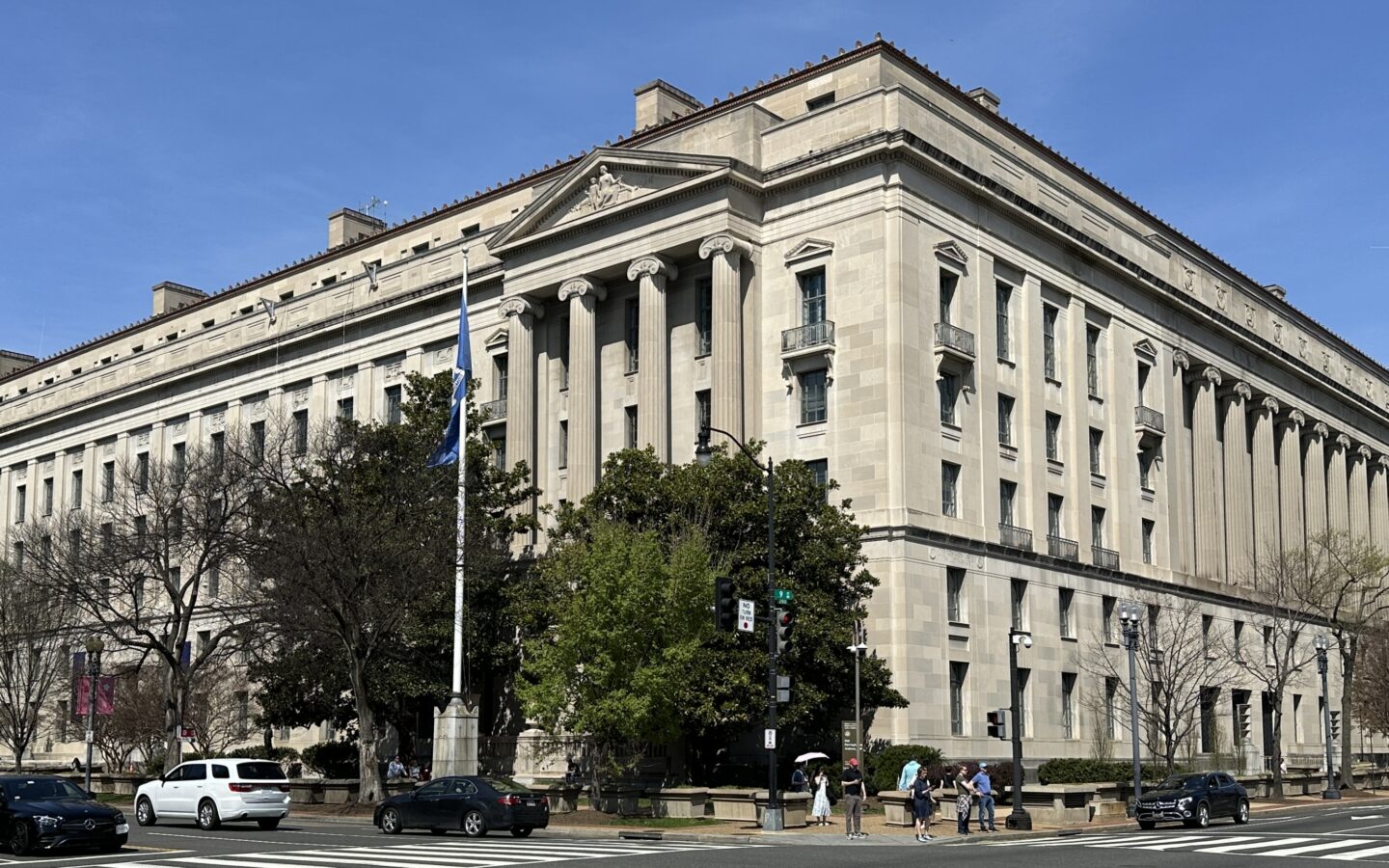
The U.S. Justice Department has opened an antitrust investigation into five major television networks over a coordinated boycott of White House pool coverage, according to reporting cited by Reuters. ABC, CBS, CNN, NBC and Fox News are under scrutiny over whether their joint decision to suspend participation in the television pool amounted to unlawful coordination among competitors. The boycott followed the White House’s decision to revoke press credentials for several organizations, a move later challenged in federal court.
The television pool is a shared system
Major networks rotate responsibility for providing video coverage that other outlets can use when space is limited. The arrangement reduces duplication and allows broad access to presidential events, but it also requires competitors to coordinate operationally.
That cooperation is routine in political journalism. The legal question is whether the networks crossed a line when they jointly suspended participation as a protest.
The boycott followed credential revocations
The dispute began after the White House revoked credentials for CNN, Politico and MS NOW. Several television networks then suspended pool participation, arguing that arbitrary access restrictions threatened press freedom.
The White House defended its authority to control access and said press credentials are a privilege rather than an unlimited right.
A federal judge intervened
U.S. District Judge Timothy Kelly later ruled that the credential ban was likely unconstitutional and ordered access restored. The boycott ended after the court decision.
The antitrust inquiry nevertheless continued, meaning the Justice Department is examining conduct that took place during a dispute already partly resolved through constitutional litigation.
Why antitrust law is being invoked
The Sherman Act prohibits competitors from agreeing to restrict output or coordinate in ways that harm competition. Group boycotts can be illegal when companies use collective action to exclude rivals or manipulate markets.
The government appears to be testing whether the networks’ joint refusal to provide pool coverage fits that framework.
Media organizations see a First Amendment issue
News outlets argue that cooperation was necessary to defend access to government information and that treating a press-freedom protest as an antitrust violation could chill collective action by journalists.
The dispute therefore sits at the intersection of competition law and constitutional rights, two areas that are not often combined in this way.
Fox News being included is notable
Fox News is generally considered more favorable to Trump than the other networks under investigation. Its participation in the boycott suggests the access dispute crossed ideological lines within the television pool.
That may complicate arguments that the action was simply a partisan effort against the administration.
The White House has challenged traditional media structures
Trump has repeatedly criticized large news organizations and expanded access for podcasts, digital creators and alternative outlets. Supporters say this broadens the media ecosystem.
Critics say the administration uses access decisions to reward friendly coverage and punish adversarial reporting.
The antitrust theory could be difficult
Operational coordination among news organizations is not unusual when they share pool responsibilities or jointly fund coverage. Prosecutors would need to distinguish between legitimate newsgathering cooperation and an agreement that unlawfully restricts competition.
The networks may argue that the boycott was expressive conduct tied to constitutional rights rather than a commercial agreement designed to raise prices or exclude competitors.
The case could reshape press-pool practices
If the Justice Department pursues enforcement, networks may become more cautious about collective responses to future access disputes. They could also redesign pool agreements to make clear when joint action is permitted.
That would have practical consequences for everyday presidential coverage, where resource sharing is essential.
Political pressure will complicate the investigation
Any probe involving news organizations and the Trump administration will face scrutiny over whether law enforcement is being used to influence coverage.
The Justice Department will therefore be under pressure to show that its legal theory is consistent with ordinary antitrust enforcement rather than political retaliation.
The underlying press-access fight is unresolved
The court restored credentials in the specific dispute, but the broader question remains: how much discretion does the White House have to determine which journalists receive access?
The antitrust investigation adds another legal front to that debate and could produce consequences extending well beyond the original boycott.
Sources
- U.S. federal court records
- Reuters, Oct. 10, 2026
- Public statements from the television networks and White House