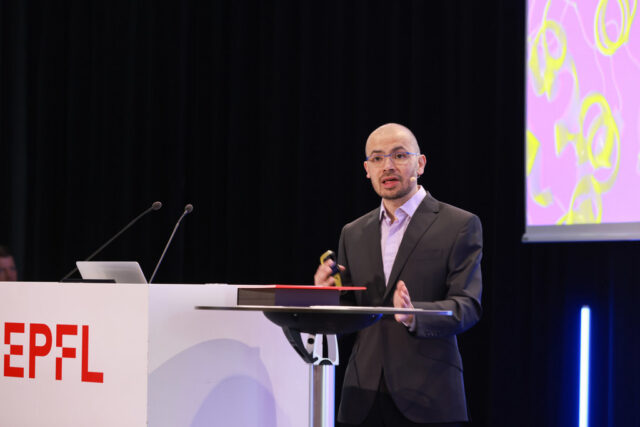
Anthropic co-founder Jack Clark told policymakers at the IMF and World Bank annual meetings that rapidly improving artificial intelligence could, under aggressive assumptions, increase U.S. economic output by nearly 50% by 2030. Clark said one internal model suggested U.S. GDP could rise from just over $30 trillion to about $44 trillion if AI capabilities continue advancing quickly and generate new industries, scientific breakthroughs and productivity gains.
The forecast is deliberately ambitious
Clark acknowledged that the estimate sounds extreme. The projection is not a conventional government forecast and depends on technological progress continuing at a very high rate.
Its importance is less the precise number than the scale of change Anthropic believes advanced AI could create in a short period.
Scientific discovery is central to the case
Clark argued that AI is becoming a force multiplier for research in mathematics, engineering, biology and drug discovery. Instead of replacing a scientist directly, advanced systems could allow each researcher to work with large numbers of digital assistants.
If that model proves effective, productivity gains could spread beyond software into medicine, manufacturing and energy.
Anthropic also warned of serious risks
The optimistic economic case came with a strong safety warning. Clark said the same systems that accelerate useful research could also make cyberattacks, biological misuse and other dangerous activities easier.
He urged governments to build rules before capabilities become too difficult to control.
Biological research drew the strongest warning
Clark said AI-assisted biology deserves particularly strict human oversight and transparency because advanced systems could help design harmful biological agents as well as useful medicines.
That risk has become one of the most sensitive issues in frontier-model safety debates.
The policy window may be shrinking
According to Clark, policymakers may have only a small number of years to build safeguards before AI becomes substantially more capable. He described evidence of a possible “singularity” in which the pace of technological progress becomes difficult for institutions to follow.
That does not mean AI is currently outside human control. Clark explicitly said humans still control today’s systems, but he argued that the situation could change quickly.
Job losses are already visible in exposed sectors
Clark acknowledged that some jobs in call centers and customer service are being reduced as AI systems automate routine interactions.
At the same time, he argued that new jobs could appear in scientific research, infrastructure and industries that do not yet exist.
Data centers become part of economic policy
If AI becomes as important as Anthropic expects, computing infrastructure will be a strategic asset. Countries able to build data centers, power generation and chip supply chains could capture a larger share of the economic benefit.
This creates a link between AI policy and energy, construction, capital markets and national security.
The financing challenge is enormous
Building frontier AI requires billions of dollars in chips, electricity and data-center capacity. Recent market volatility has shown that investors are increasingly questioning whether expected AI revenues will justify the debt and capital spending required.
That means a productivity boom could still be constrained by financial conditions.
International cooperation will be difficult
Clark called for global coordination, but major powers are simultaneously competing for leadership in chips and AI models. Export controls, data rules and national-security restrictions can make cooperation harder.
Governments therefore face a dual challenge: coordinate on safety while competing on economic advantage.
The debate is moving from possibility to timing
Only a few years ago, policymakers debated whether AI would meaningfully affect macroeconomic growth. The current debate is increasingly about how quickly the impact arrives and whether institutions can adapt fast enough.
Clark’s $44 trillion scenario is far from guaranteed, but it illustrates why AI is now being discussed alongside debt, inflation and energy at the world’s biggest economic policy meetings.
Sources
- Jack Clark remarks at the IMF and World Bank Annual Meetings, Oct. 17, 2026
- Reuters, Oct. 17, 2026