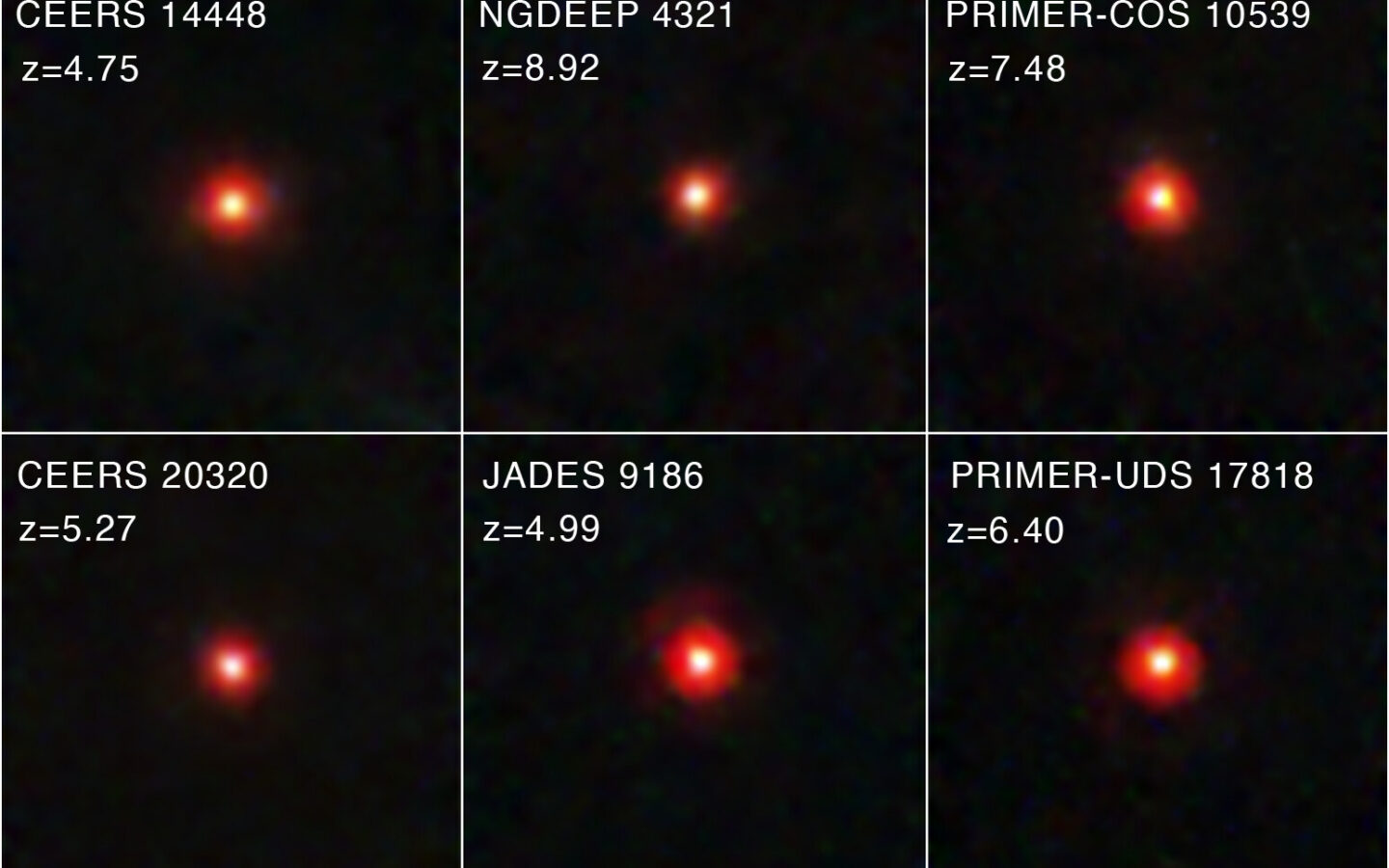
A new set of cosmological simulations may explain one of the James Webb Space Telescope’s most puzzling discoveries: compact objects known as “little red dots” that appear unusually common in the early universe.
Researchers led by Sunmyon Chon used Japan’s ATERUI III supercomputer to model the birth and growth of massive black-hole seeds. The work, published in Nature, found that intense ultraviolet radiation in dense young-galaxy environments can suppress ordinary star formation and instead help create very massive stars that collapse into black holes.
Rapid growth without exotic assumptions
The simulated black holes formed inside dense, optically thick gas disks and then grew at rates far above the standard Eddington limit for short periods. Their predicted light signatures resembled the red, compact sources Webb has observed.
The result does not prove that every little red dot is the same kind of object. Astronomers are still debating the mix of stars, dust and active black holes responsible for different observations. But the model provides a physically connected route from early massive seeds to the unexpectedly large black holes Webb has found less than a billion years after the Big Bang.
Future spectroscopy and deeper surveys will test whether the simulated signatures match a broader sample of little red dots.