
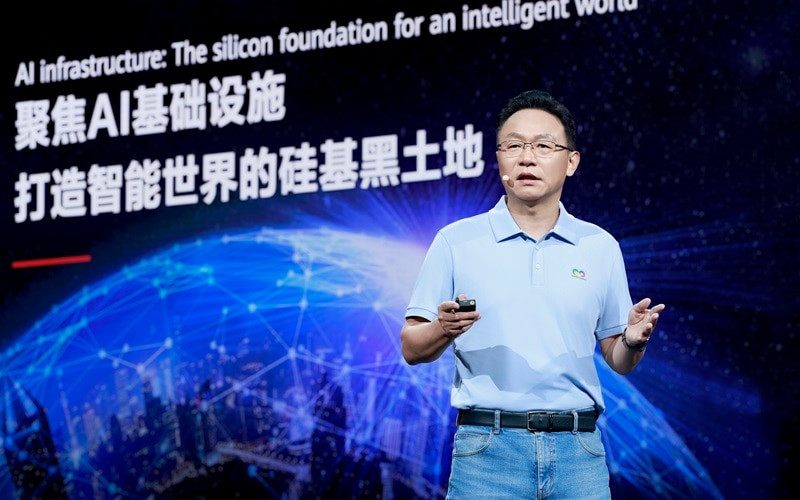
Huawei has accelerated the rollout schedule for its next generation of Ascend artificial-intelligence chips as it pushes deeper into large-scale computing infrastructure. At HUAWEI CONNECT 2026 in Shanghai, the company said the Ascend 960DT is now expected in the first quarter of 2027 and the Ascend 960PR in the third quarter, both earlier than previously planned.
The company also unveiled the Atlas 960E SuperPoD, a system designed to connect thousands of AI processors through high-speed optical interconnects. Huawei says a single Atlas 960E can scale to 4,096 NPUs and deliver up to 8 EFLOPS of FP8 compute performance, while its broader SuperCluster architecture can scale far beyond a single system.
A systems-level strategy for AI infrastructure
Rather than competing only on the performance of an individual accelerator, Huawei is emphasizing system architecture, memory bandwidth and interconnect technology. Its UnifiedBus platform is intended to make large numbers of processors behave more like one coordinated computing system, while the company’s new Hi-ONE near-packaged optics product is designed to reduce power use and the number of conventional optical modules required.
Huawei said development of the Ascend 960 has progressed faster than expected, and that it plans to maintain a one-generation-per-year cadence after 2027, with Ascend 970 and 980 products targeted for 2028 and 2029.
China’s AI infrastructure race intensifies
The announcement comes as demand for AI computing capacity continues to rise sharply in China. Reuters and AP reported that Huawei sees strong domestic demand for its AI systems while it works to narrow the gap with established global leaders. U.S. export restrictions on advanced chips have also encouraged Chinese technology companies to invest more heavily in domestic hardware and software ecosystems.
Huawei says its open computing ecosystem now includes millions of developers and growing support for mainstream AI frameworks. The key test will be whether its combination of chips, interconnects and software can deliver competitive performance at scale while keeping power consumption and system complexity under control.