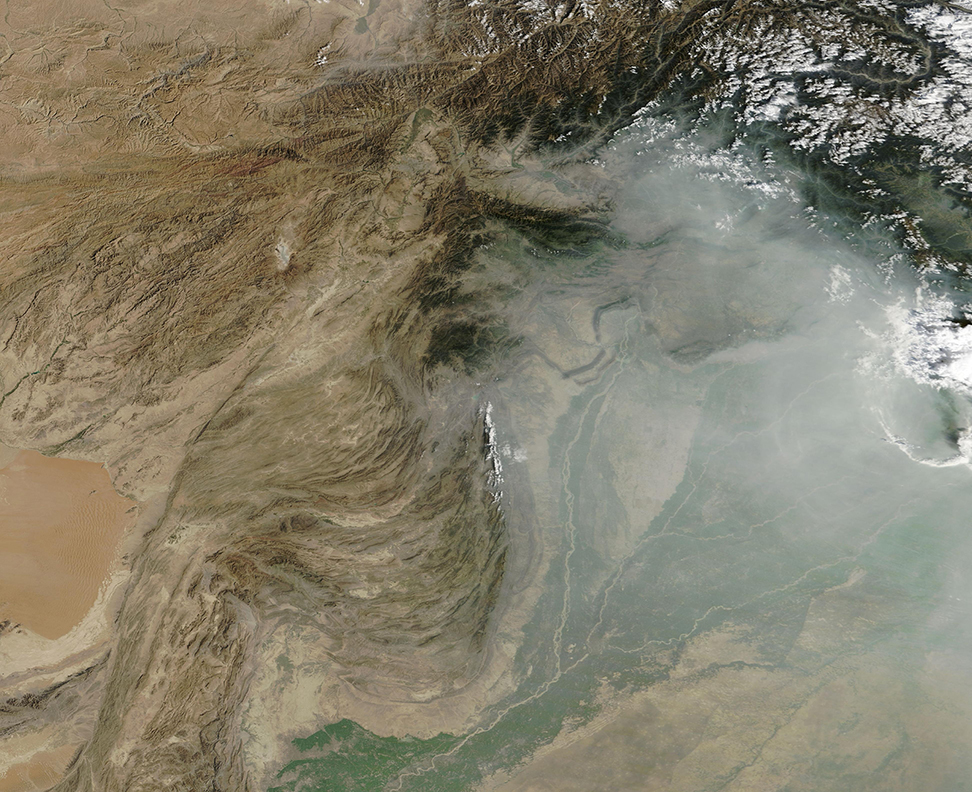
A NASA satellite image released on September 27 shows a broad layer of gray haze covering northern Pakistan, highlighting the mixture of aerosols that can build up over the region during periods of stagnant weather.
The Moderate Resolution Imaging Spectroradiometer, or MODIS, aboard NASA’s Terra satellite captured the true-color image on September 24.
Smoke, dust and urban emissions can all contribute
NASA says aerosols over northern Pakistan can come from several sources. Agricultural fires are one contributor, while dust can move into the region from the Thar Desert. Vehicle emissions, industrial activity, construction, fireworks and household heating or cooking fires may also add particles to the air.
The satellite image does not identify a single source for the haze. Instead, it shows the visible result of multiple types of particles suspended in the atmosphere.
Temperature inversions can trap pollution
Cooler weather can make poor air quality worse by creating temperature inversions. Under normal conditions, warmer air near the ground can rise and help disperse pollution.
During an inversion, a layer of warmer air sits above cooler air near the surface and acts like a lid. Pollutants can then remain trapped closer to the ground instead of mixing upward through the atmosphere.
NASA notes that inversions are common in the region when cold air moves down from the Tibetan Plateau and interacts with polluted air at lower elevations.
Terra has monitored Earth for decades
Terra is one of NASA’s long-running Earth-observing satellites. Its instruments have been used to track fires, clouds, aerosols, vegetation, land temperatures and other changes across the planet.
The September 24 image was produced by the MODIS Land Rapid Response Team at NASA’s Goddard Space Flight Center.
Satellite observations cannot replace ground-level air-quality measurements, but they provide a broad view of how pollution and haze spread across large regions. In this case, the image offers a clear snapshot of the atmospheric conditions over northern Pakistan in late September.